If you didn't happen to have an old maid's uniform laying around they also say you could check your scrapbag. "Odd scraps of colorful fabric are combined with great success."

"Learning to fit and make pretty clothes on a modern fashion model means that half the battle's won to young sewers when they come to make their own. Glamor clothes, slacks, dirndls, etc. (1058) look adorable on such fashion models, which are usually about 12 1/2 to 20 inches high."
These illustrations are signed Jean De Vigne who I can find listed as an illustrator on some book covers, but no other details. Any ideas?
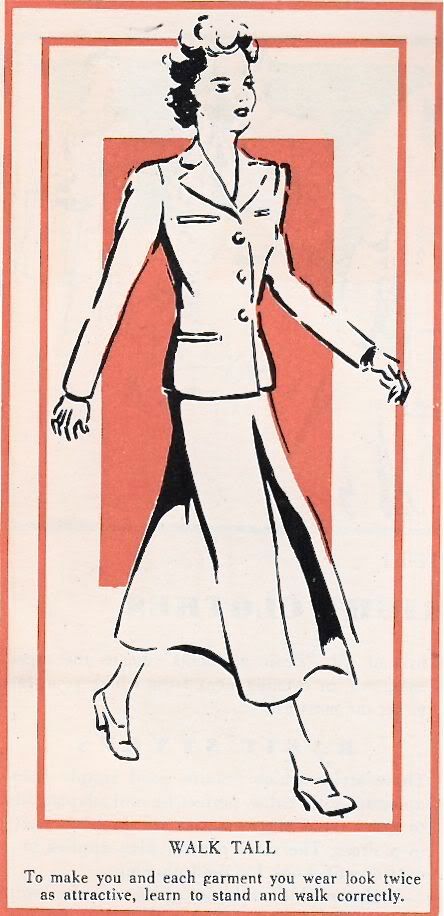
THE SEERSUCKER SUIT is a grand institution. This black-and-white one has the short length jacket, and a skirt eased by kick pleats stitched along the edge to keep them crisp. Wear it with blouses or dickeys. No. 5244.
THE SEMI-FITTED REEFER at the right, and turning its back to you above, will soon start collecting admirers. It is just a shade more mannish than most reefers. And this cut makes it wonderful for bulky tweeds. No. 5248.
THE BOXY SHORTIE in yellow wool is a very gay little sports coat which you put on over your suit on shivery days, and wear with shorts, slacks, and extra skirts during the summer. It's double breasted, No. 5247.
COAT OF MANY USES - It is the boxy one shown here twice. Make it as long as the beige, and it is a coat you can use for spring, summer and fall. Make it as brief as the red, and this is a toss-on shortie which you can wear with suits, slacks, shorts and all extra skirts. No. 5242.
CLASSIC COAT FOR TOWN WEAR - It is the reefer, of course. The spring reefer above can be a fall reefer too, if you choose the right color. It is fitted by flattering long, narrow panels, which make one's figure as slim as slim. Good sharp collar, set-in pockets. No. 5211.
"TAILORED BUT SOFT"--This describes at least half of the new shirtfrocks. Everybody can find a becoming one, now. The yellow dress falls into this softly tailored class, with its curved yokes and the gathers below them. No. 5229
COLLARLESS SHIRTFROCK--Many women like everything about a shirtwaister except its notch collar. The flame-colored dress is for them. The skirt is interesting. It has eight slim gores, the front ones saddle-stitched, No. 5217.
ONE FOR VERY BEST--The green dress is illustrated in a good rayon crape, tested rayon. This is one of the best of the draped style, and simpler to make, really, than a tailored frock. Very nice, too, made of a semi-sheer. No. 5225.
For Collage gals the "peplum is the big attraction". But to wear the navy dress "you have to be young". The yellow dress looks "particularly nice on girls with curls". And of course the pink print is "pretty, summery looking, cool. Of course!
One illustration is signed by Blanch Rothschild, who I could only find listed as an American Artist - 1893-1988.
This is a Spring Wardrobe.
The first set include the aqua dress, that is "especially for those who say, 'I can't wear shirtfrocks, they are too severe'. You can wear this one." The dotted crepe, "worn with town accessories, it looks like a soft suit." The Navy with "lingerie touches" has a "swing-over neckline."
To Keep for Summer
There are plenty of details to enjoy here, but I have to admit I think the gray with the contrast bodice does it for me. But maybe I'm influenced by her cute little hat. They do say that it is "a wonderful idea for getting one new dress out of two old ones". Remember this was wartime. The red dress "uses the border edge at the hemline only, which is smart of it.". The blue dress uses eyelet and it is "A good shoulder-broadening style. Use a piece of leftover material, printed or striped, can be used up smartly for yokes and sleeves, as in the white dress".
Yep, that Helen is headed for trouble. After all "people who are busy winning a war don't find dimwits amusing!"

"Chen Yu
For centuries and despite all wars, beautiful hands with long and well cared for have been attractive.
These hands are an inspiration ...
And now they can be more charming than ever
Use Lacquerol basis.
The most beautiful varnish to your nails"
This is from a 1943 La Familia, a magazine that comes from Chile. But we don't need to translate this to get the message. These are some nails!